Tuesday, 18 February 2014

Practicing with Chiishi

Chiishi can be used to practice blocks and strikes. Shown below is how to practice ura ken uchi (literally "Back Fist Strike") while gripping the chiishi in one's fist.  Key points include (a) extending the fist fully back during the actual strike so the knuckles are pointing directly behind oneself, (b) looking at where one's opponent would be, and (c) maintaining a vigilant position with the unused hand. After practicing strongly and steadily with the chiishi, students should always put the implement down and do some more practices at usual speed - lighter and quicker "snapping" movements, but with the arms "remembering" the  weight of the chiishi.


Above & below: Practicing upper body Ura Ken Uchi with the Chiishi


Friday, 14 February 2014

Chiishi

Chiishi is one of the traditional implements used in Okinawan GoJuRyu Karate training.  These implements are very simple and therefore highly flexible and effective. The chiishi consists of a wooden handle embedded in a circular stone or concrete block.  It is used to condition and strengthen the grip, wrists, arms, upper body, blocking and stances.  Its essential simplicity means there many different exercises that can be done with the chiishi.  Some examples of these will be shown in future posts.  More information can be found at this site.


Tuesday, 11 February 2014

Dojo Etiquette

Before entering the dojo, one should remove all layers of outer clothing – hats, scarfs, overcoats, gloves, hoods. Generally one does this outside, though some dojos allow you to do it immediately after entering in winter, if the weather is very cold.  

Upon entering, one shouts “Onegaishimasu” in a loud, clear and enthusiastic voice, announcing one’s presence and helping to develop Ki (or Qi in Chinese).  

The same applies when leaving – outer layers of clothing should not be put on until one has bowed to the altar or shrine (top center in the photo) at the front of the dojo, One then shouts “Arigatou Gozaimashita.” Outside, one can finish dressing.  

The removal of outer clothing is basic manners, but it is also to show that one is not carrying anything concealed, and comes with peaceful intentions.


Monday, 10 February 2014

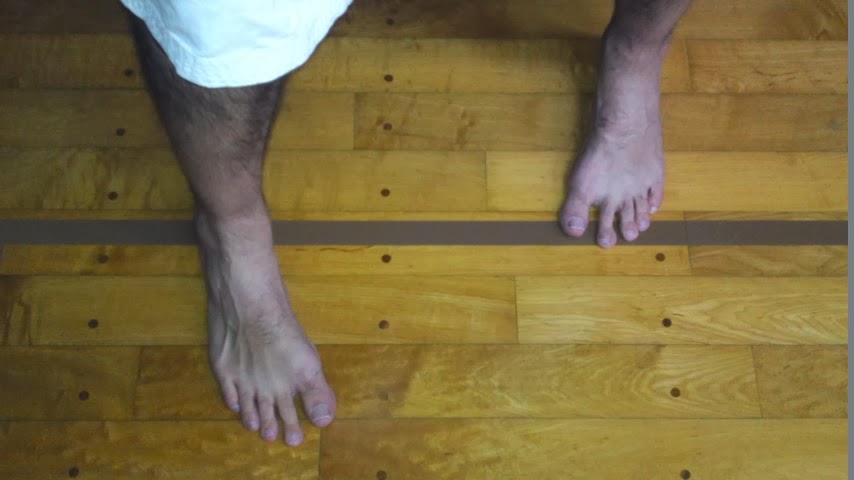
Sanchindachi

Sanchindachi is one of the stances of GoJuRyu, and perhaps the most important.  It is done with the feet shoulder-width apart, one foot in front of the other, the heels turned slightly outwards (so that two imaginary lines extending in the direction the toes are pointing would intersect directly in the center of one's opponent's body). The toes are opened, not clenched, and grip the floor, generating a slight torque which is maintained up the inside of the legs and into the buttocks and tanden. 


The center of gravity is kept low and the body "locked up" to make the stance a strong one.  C. W. Nicol puts in nicely in Moving Zen, his account of studying Shotokan in Japan in the 1960s:


"The stance of the Karateka roots him to the earth at the moment of impact. For a split second in time he is a statue, like a stone from the earth, and then, after the blow is delivered, he relaxes and his body recoils in preparation for the next move, taking more of the water from from which most of his body is made up. Stone, earth, water. Movement and non-movement."

However, with sanchindachi, there is no relaxing - the tension is maintained throughout


Saturday, 8 February 2014

Some Myths about Karate 2


A second “myth” about Karate (and Martial Arts in general) is that there are traditionally many different colors of belt used in rankings.  It is true that now, as well as white belt, there are often yellow, green, brown (and even blue and red) belts awarded as one progresses through the nine or ten Kyu grades before obtaining a black belt as Dan.  These colors are a relatively recent addition, a visual incentive to encourage students to push on and strive for the next grade, as well making it easier to tell who is at what level during classes and tournaments. 
However, traditionally, there was only a white belt, signifying the spiritual purity necessary to practice the deep philosophy of the Ways.  As one practiced over the years, this white belt gradually acquired a patina of stains and darkened in color, so that those who had advanced and attained some degree of mastery eventually had “black belts.”  The true color for anyone’s belt in Karate, therefore, is white. 

Note: Black belts are black only on the outside.  Over the years they fray to reveal a white interior.  One can gauge, therefore, how long someone has been a black belt by how much white is showing.  It is an irony, therefore, that some new black belt students repeatedly wash their belts to advance this fraying process and make them look more like seasoned veterans. 


Wednesday, 5 February 2014

Some Myths about Karate 1


One myth is that "karate" means “empty hand.”  The Chinese kanji characters used to write the word nowadays do translate as such, and are a useful epithet for “unarmed.”  But karate came to Japan via Okinawa, which during the Edo period of Japanese isolation was one of the few places to have continuous contact with the outside world. During this period, Okinawans visited China, studied Shaolin Kung Fu and brought it back with them.  Karate was brought to mainland Japan from Okinawa by Mr. Gichin Funakoshi in 1922. At that time, the kanji characters used meant “Chinese hand.” It was only later, under Japanese imperialism, when all things Chinese were scorned, that the kanji was changed to “empty” instead of “Chinese” – both pronounced “kara” in Japanese.  In Okinawa, however, karate is simple referred to as “Te” or hand. And in the Okinawan dialect, this is pronounced “Tea” – as in the drink. Karate-do, the Way of Tea!


Monday, 3 February 2014

Dojo Kun

Back at the dojo after missing a couple of sessions due to work.   Worked out with my old friend David and went through all the kata.  Also practiced with the chishi (more on those in future posts).  Finished as always with the Dojo Kun. 

The Dojo Kun or precepts are shown on the wall of the dojo and recited by all students at the end of each session, while kneeling with eyes closed and facing the altar or shrine.  

They are read from top to bottom and right to left, in the traditional Japanese way. They can be roughly translated as
1. Strive to perfect one’s character
2. Always be respectful and polite
3. Be wary of losing one’s temper or getting hot headed
4. Cultivate a spirit of endeavor
5. Follow the path of sincerity

Everyone then bows to the shrine, next to the head of the dojo, and then to the instructors and each other.


Wikipedia states that GoJuRyu has eight precepts, but this is not the case at RyuShinKan.

The Dojo Kun displayed on the wall at RyuShinKan